2026-04-21
UNESCO Chairs at MCI and PH NÖ, in collaboration with the Federal Ministry for Women, Science, and Research (BMFWF), publish the Reference Framework for Futures Literacy in Austrian Higher Education
Innsbruck/Vienna, April 2026 – On the occasion of the UN World Day of Creativity and Innovation on April 21, the new reference framework FuturesComp will be presented to a wider public for the first time. It was developed by the UNESCO Chair in Futures Capability for Innovation and Entrepreneurship at MCI in collaboration with the UNESCO Chair in Learning and Teaching Futures Literacy in the Anthropocene at the University College of Teacher Education Lower Austria (PH NÖ) on behalf of the Federal Ministry for Women, Science, and Research (BMFWF).
FuturesComp addresses a central challenge of our time: How can universities prepare students for a future characterized by uncertainty, complexity, and profound transformations? As a practice-oriented reference framework, it offers, for the first time, a structured foundation for systematically embedding futures literacy in teaching, curricula, and university development.
Futures literacy—highlighted by UNESCO as a key competence of the 21st century—describes the ability to explore different future scenarios, reflect on them critically, and actively help shape them. At the heart of FuturesComp are five interconnected competency areas: exploration, shared responsibility, shaping, self-development, and participation in relation to so-called POLY-futures—that is, the diversity of possible and shapeable futures.
The framework is supplemented by concrete learning objectives, learning outcomes, didactic approaches, and next-practice examples that support educators in implementing the framework across various disciplinary contexts. Methodologically, the FuturesComp is grounded in a comprehensive literature review, expert discussions, and participatory workshops with national and international stakeholders from academia and higher education practice.
In addition to its significance for higher education, the FuturesComp also provides an impetus for education policy: It demonstrates how universities can create learning spaces in which the future is not only analyzed but also reflected upon and responsibly shaped.
👉 Access the report:
Download FuturesComp in German: https://doi.org/10.53349/oa.2025.a2.200
Download FuturesComp in English: https://doi.org/10.53349/oa.2026.a2.230
Here you find the official MCI press release (German)
Follow us on LinkedIn and stay up to date!
Share Content


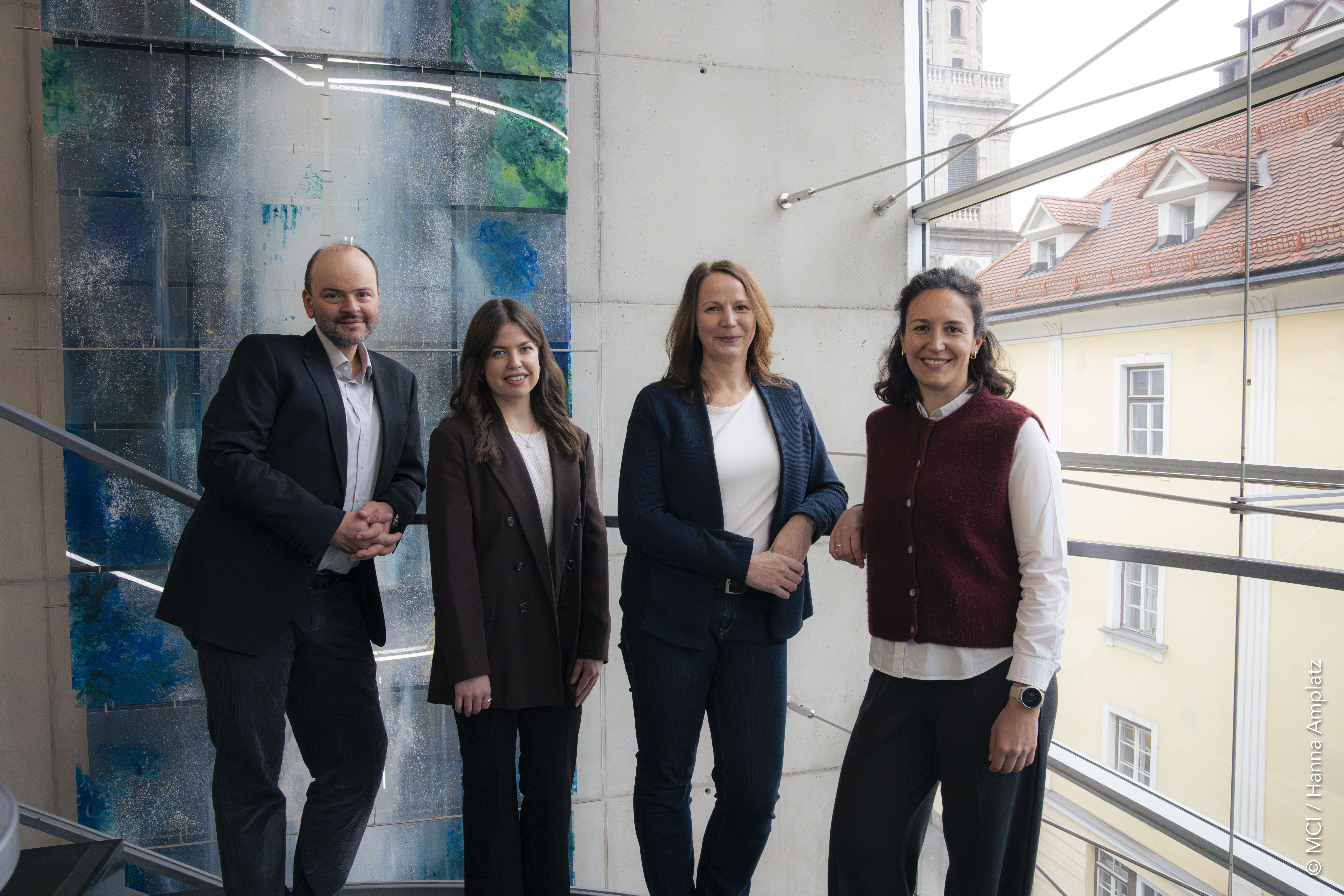
Image 1: MCI project team, from left to right: Oliver Som, Julia Vögele, Antje Bierwisch, Juliana Pattermann-Gunsch © MCI/Hanna Amplatz

Image 2: FuturesComp Key Competencies © Federal Ministry for Women, Science, and Research (BMFWF)